Carl Jung said something that has stayed with me for years: "Until you make the unconscious conscious, it will direct your life and you will call it fate."
It's one of those lines that sounds profound the first time you hear it and gets more profound the longer you sit with it. Because the longer you meditate, the more you realize: that's not a metaphor. It's a literal description of what meditation does.
Most of what runs your life — your reactions, your assumptions, your emotional patterns, your habitual ways of interpreting the world — operates below the threshold of awareness. Not in the Freudian sense of being hidden in some inaccessible vault, but in a simpler, more verifiable sense: you're doing it, but you don't know you're doing it. And because you don't know, you can't choose. The pattern runs. You react. And afterward you wonder why you said that, or felt that, or did that thing again.
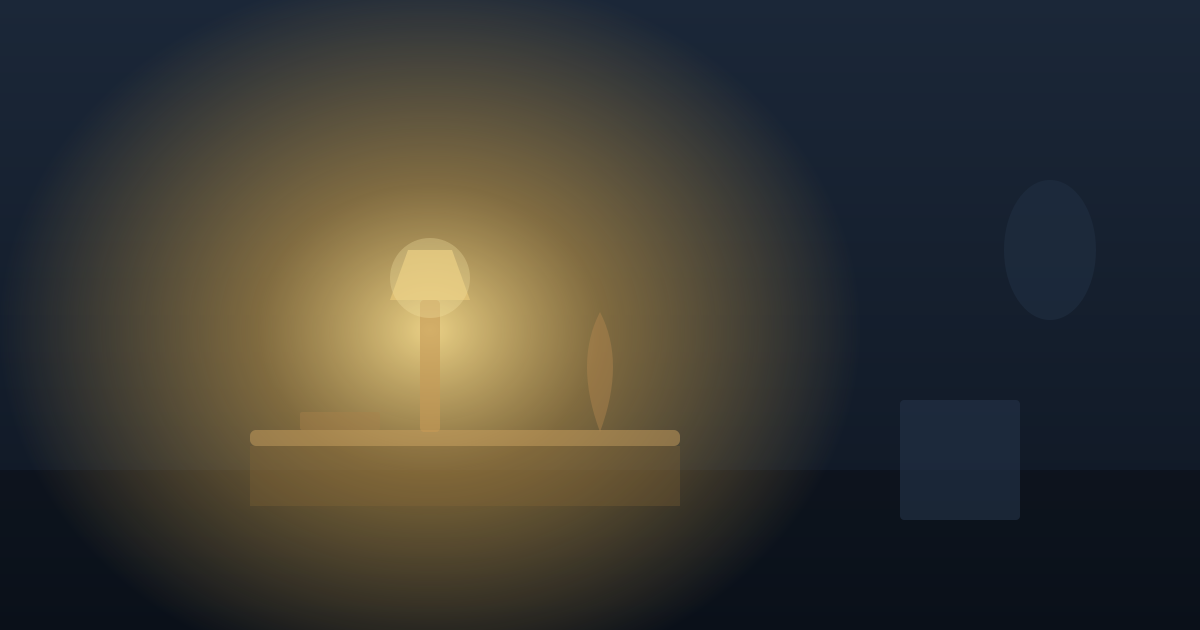
Meditation is, at its core, the practice of making more of this visible. Of expanding the lit area. Of bringing the lamp into the dark room.
Three levels, not two
Most people think of consciousness as binary: you're either aware of something or you're not. Conscious or unconscious. Light or dark. But cognitive scientist Jonathan Schooler showed that the reality is more nuanced than that — and the nuance is exactly where meditation operates.
Schooler identifies three levels:
Non-conscious. Processes you never experience. The neural calculations that adjust your heart rate, regulate your hormones, process visual data before it reaches awareness. These are genuinely invisible to you, and meditation doesn't change that.
Conscious without meta-consciousness. This is the critical middle zone. You are experiencing something — a thought, an emotion, a bodily sensation — but you don't know you're experiencing it. The experience is happening, but you haven't noticed that it's happening.
This sounds paradoxical, but you know it from everyday life. You've driven home on autopilot and arrived without remembering the drive. You were conscious the whole time — you stopped at red lights, navigated turns — but you weren't meta-conscious: you didn't know what you were doing while you were doing it.
Meta-conscious. You explicitly know what you're experiencing. You're aware of being aware. You can name what's happening: "I'm anxious right now." "I'm lost in thought." "I'm planning tomorrow's meeting instead of being here."
Schooler's key insight: the gap between the second and third levels — between having an experience and knowing you're having it — is where most of human life takes place. And it's precisely this gap that meditation trains you to close.
What this looks like in practice
Every meditation session is a live demonstration of Schooler's three levels.
You sit. You find your breath. You know you're following your breath. That's meta-consciousness — level three.
Then, gradually, a thought arises. It's not unconscious — you're experiencing it. But you don't know you're experiencing it. You've left the breath, entered a daydream, and the part of your mind that monitors what you're attending to has gone quiet. You're at level two: conscious but not meta-conscious.
Then — the catch. You notice. "Oh. I was thinking about dinner." Meta-consciousness comes back online. You see that you weren't seeing. You've moved from level two to level three.
That moment of catching is, I've come to believe, the single most important moment in meditation. Not the focused part. Not the still part. The part where you wake up to what was already happening. That's the light entering the dark room.
Layers of darkness
Here's where it gets interesting. The "unconscious" material that meditation reveals isn't all one kind. Over years of practice, I've noticed — and the psychology maps onto this — that there are layers, and they get progressively more subtle.
Layer one: Habitual autopilot. These are the procedural patterns, the behavioral ruts, the automatic reactions that run without awareness. In meditation, this is the basic mind-wandering: you set out to follow the breath and find yourself, three minutes later, planning a holiday. You weren't aware of the transition. The autopilot took over seamlessly.
This is the layer that Shamatha — concentration meditation — primarily addresses. Each time you notice the wandering and return, you're making this layer more visible. Over weeks and months, you catch the transitions earlier and earlier. The autopilot still runs, but you see it running.
Layer two: Avoided emotions. Beneath the habitual level lies material that's been pushed out of awareness because it's uncomfortable. Not forgotten — you could access it if you looked — but systematically avoided. A grief you haven't fully felt. An anger you've decided is unacceptable. A vulnerability you've walled off.
In meditation, this layer shows up when you've been sitting for a while and something unexpected surfaces — a sadness you didn't know was there, an old memory with a charge you thought was spent, a fear that doesn't connect to anything in your current life. It's material your mind has been quietly maintaining below the waterline, and the stillness of meditation allows it to rise.
This is the layer Jung was primarily concerned with — the shadow, the parts of ourselves we've exiled because they don't fit the self-image we've constructed. And it's the layer where meditation needs heart. Because seeing this material without warmth — without self-compassion, without the willingness to let it be there — can be more harmful than not seeing it at all. Blotting-paper exposure without care is just retraumatization. Seeing with care is integration.
Layer three: Structural patterns. Deeper still are the cognitive schemas — the organizing frameworks that aren't individual thoughts but generators of thoughts. Aaron Beck's "core beliefs." The underlying assumptions that color everything: "I'm not good enough." "The world is unsafe." "I don't belong."
You don't see these as thoughts. You see through them, like glasses you don't know you're wearing. They're the reason certain thoughts keep coming back: not because the thoughts themselves are sticky, but because the lens keeps regenerating them.
In meditation, this layer reveals itself slowly — over months or years — when you begin to notice that many apparently different thoughts are variations on the same theme. The work worry, the relationship anxiety, the social comparison — they're all expressions of one underlying structure. Seeing the structure is a different order of insight than seeing any individual thought. It's the moment you realize you've been wearing glasses.
Layer four: The constructed self. The deepest layer — and the one that goes beyond what most secular meditation addresses — is the construction of the experiencer itself. The sense of being a solid, continuous self who has thoughts and feelings. The subject-object structure that organizes all experience into "me here" and "world out there."
Contemplative traditions describe glimpses of this layer dissolving — moments where the usual sense of self softens or temporarily drops away, revealing something more open and less boundaried. The neuroscience is only beginning to map this territory. But it's worth knowing that the traditions describe it, and that for some people, a sustained meditation practice will eventually approach it.
I mention this last layer not because it's within reach of a daily fifteen-minute practice, but because it completes the map. It's the horizon that gives the journey direction.
Why seeing changes everything
Here's the part that took me years to understand: you don't need to do anything with what you see. The seeing itself is the change.
This sounds like mystical hand-waving, but the psychology supports it. Research in Mindfulness-Based Cognitive Therapy (MBCT) shows that metacognitive awareness — the ability to see thoughts as thoughts — is the specific mechanism that prevents depressive relapse. Not changing the thoughts. Not arguing with them. Not replacing them with positive ones. Just seeing them as mental events rather than facts.
Acceptance and Commitment Therapy (ACT) calls this cognitive defusion: the moment you see that you're fused with a thought is already the beginning of defusion. You can't be fused with something you're looking at. The observation itself creates distance.
And the contemplative traditions say the same thing, often more directly. In the Mahamudra tradition, the instruction is: look directly at the thought. What is it? Where is it? What happens when you look? And the discovery, consistently, is that the thought — when met with clear, direct seeing — doesn't hold up. It doesn't have the solidity it seemed to have when you were inside it. It's more like a cloud than a wall.
The looking is the liberation. Not because the thought disappears (sometimes it does, sometimes it doesn't), but because the relationship to it changes irreversibly. Once you've seen that a thought is a thought and not a fact, you can never quite un-see it.
But the light needs warmth
There's a caveat to all of this, and it's important enough that I want to be explicit about it.
Making the unconscious conscious is not always comfortable. In fact, at layer two and beyond — when you start encountering avoided emotions and structural patterns — it can be genuinely painful. The material was avoided for a reason. It hurts.
Jung knew this: "To confront a person with his shadow is to show him his own light." But showing someone their shadow without care is just cruelty. The light needs warmth. The seeing needs heart.
In practical terms, this means that meditation is not purely a cognitive exercise. The self-compassion that Kristin Neff describes — self-kindness, common humanity, mindful awareness — isn't a nice-to-have addition to meditation practice. It's load-bearing. It's what allows you to see difficult material without being destroyed by it.
When you discover, in meditation, that you've been carrying a core belief of inadequacy for decades — that discovery needs to be met with warmth, not clinical analysis. "Ah, there it is. That old pain. I see you. I'm here." That's the integration Jung was talking about. Not eliminating the shadow, but including it — with compassion.
A meditation teacher I respect once said: insight without compassion is just a better view of the wreckage. Insight with compassion is the beginning of repair.
The lamp in the dark room
The Tibetan tradition uses an image I come back to again and again: a lamp in a dark room. The room has always been there. The objects in it have always been there. The lamp doesn't create anything new. It reveals what was already present.
Meditation is the lamp. The room is your mind. The objects — the habits, the emotions, the patterns, the beliefs — were there before you sat down. They'll be there tomorrow. But each time you sit and bring the light of awareness to them — gently, patiently, warmly — a little more of the room becomes visible. A little more of what was directing your life without your knowledge becomes something you can see, and choose about, and hold with care.
Jung called it making the unconscious conscious. Schooler calls it the shift from consciousness to meta-consciousness. The meditation traditions call it waking up. They're all describing the same movement: the expansion of the lit area, one session at a time, one gentle return at a time.
It doesn't happen all at once. It doesn't happen dramatically. It happens the way dawn happens — so gradually that you don't notice the moment it changes, until you look around and realize you can see.
The bottom line
Meditation doesn't give you a different mind. It gives you access to the mind you already have. Most of what drives your behavior, your emotions, and your reactions operates in the zone Schooler identified: conscious but not meta-conscious. You're doing it, but you don't know you're doing it.
Every time you sit and catch your mind wandering, you're closing that gap — making one more tiny thing visible that was invisible before. Over time, the cumulative effect is a life in which you're directed by less and choosing from more.