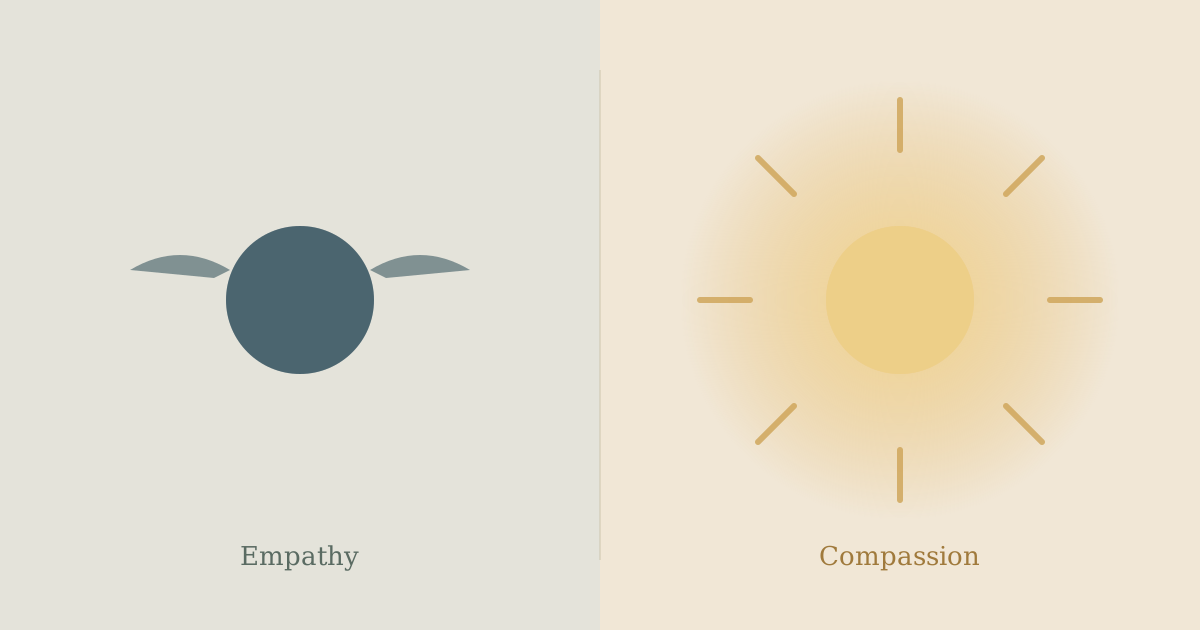
Most people use "empathy" and "compassion" interchangeably. It turns out they're fundamentally different — in how they feel, in what they do to your brain, and in whether they sustain you or burn you out. Understanding the difference made a change for me, and I think it might matter for you too.
The experiment that changed the field
In 2014, Tania Singer and Olga Klimecki at the Max Planck Institute ran an interesting study. They took a group of participants, trained them first in empathic resonance — the skill of feeling what another person feels — and measured their brain activity while they watched videos of people suffering.
Then they trained the same participants in compassion meditation and ran the measurements again. The results were striking.
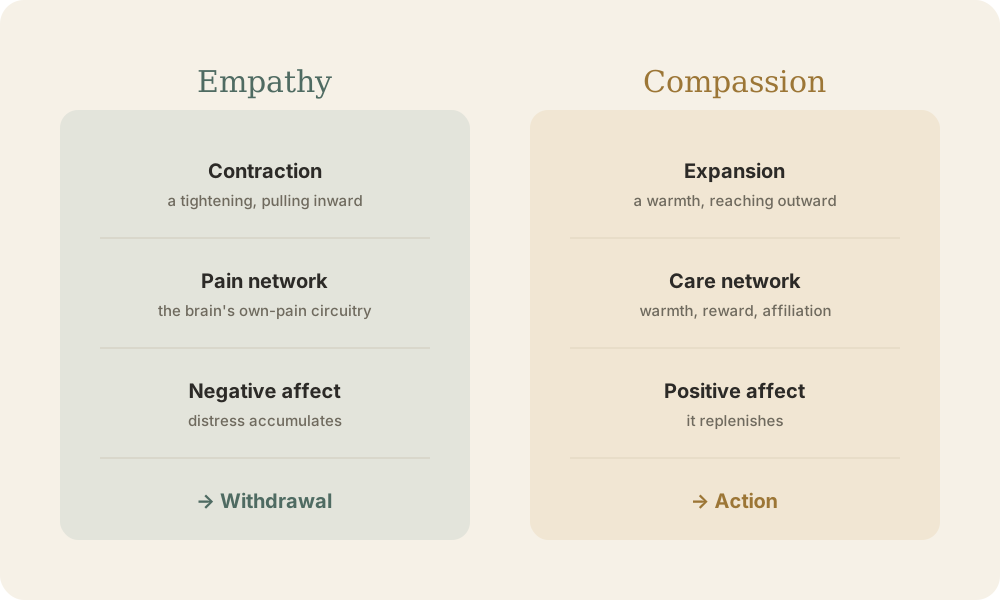
After empathy training, participants reported increased negative emotions. Their brains showed heightened activity in the anterior insula and anterior midcingulate cortex — the same regions that activate when you yourself experience pain. In a very real, neural sense, watching someone else suffer was making them suffer too.
After compassion training, the picture reversed. Negative emotions decreased. Positive emotions increased. And a completely different neural network lit up — the medial orbitofrontal cortex, the ventral striatum, areas associated with warmth, reward, affiliation and parental care.
Same people. Same videos of suffering. Radically different inner experience — depending on which mental skill they were using.
What empathy actually is
Empathy is resonance. When you see someone in pain and feel a pang in your own chest, that's empathy. Your brain is running a partial simulation of their experience. The neural circuits that process your own pain are activating in response to their pain.
This is evolutionarily useful. It gives us rapid, embodied information about what others are experiencing. It's the foundation of social bonding. Without it, we'd be unable to understand each other at the visceral level that makes relationships work.
But empathy has a structural limitation: it's isomorphic. It mirrors the other person's state. If they're suffering, you suffer. If they're anxious, you feel anxious. The emotional flow runs inward — their pain becomes your pain.
And accumulated inward flow, without something to transform it, leads to what Singer calls empathic distress: exhaustion, overwhelm, withdrawal. The nurse who, after twenty years, can no longer look at patients. The friend who stops calling because your problems are too heavy. The meditator who avoids sitting with difficult emotions because it's just too much.
For decades, this was called "compassion fatigue." But Singer's research shows that's a misnomer. It's not compassion that fatigues. It's empathy — raw, untransformed empathy. The distinction matters enormously.
What compassion actually is
Compassion is not feeling the same as the other person. It's feeling warmth and care toward the other person. It's not "I feel your pain." It's "I see your pain, and I wish you to be free of it."
The difference seems subtle in words. In the body and brain, it's anything but.
Where empathy feels like contraction — a tightening in the chest, a heaviness, a pulling-inward — compassion feels like expansion: warmth, openness, a sense of reaching toward. Where empathy activates the brain's pain circuitry, compassion activates the brain's care and affiliation circuitry — the same networks involved in parental love and close bonding.
And here's the key finding: compassion is not depleting. It's restorative. The neural system it activates is designed for sustained caregiving — it's the system that allows parents to care for infants through months of sleep deprivation without (entirely) collapsing. Compassion doesn't drain the battery. It's a different kind of battery altogether.
Matthieu Ricard — a Tibetan monk and one of Singer's research subjects — described the experience from inside the scanner. When asked to practice empathic resonance with images of suffering children, he reported that the sharing of their pain quickly became unbearable, like emotional burnout. But when he switched to compassion meditation, the entire landscape changed. The images were still vivid. But instead of distress, he felt a strong sense of warmth, care and resolve.
The fork in the road
Singer's model describes a fork. When you encounter someone's suffering, two things can happen:
Path A: Empathy → self-other differentiation holds → the feeling is transformed into compassion → you feel warmth and motivation to help → you can keep caring.
Path B: Empathy → self-other differentiation collapses → their pain becomes your pain → you feel distress → you withdraw to protect yourself → you stop caring.
The difference between the two paths is a specific capacity: the ability to feel someone's pain without becoming their pain. To be touched without being overwhelmed. To stay connected without losing yourself.
If that sounds like something meditation trains — it is. That's exactly what it trains.
Where meditation comes in
The capacity to stay present with difficult experience without being overtaken by it is precisely what contemplative traditions have been cultivating for millennia. It has different names in different frameworks:
In Acceptance and Commitment Therapy, it's called cognitive defusion — seeing a thought or feeling as a mental event, rather than being swallowed by it.
In Bernstein's metacognitive model, it's called decentering — meta-awareness, dis-identification, and reduced reactivity working together.
In the meditation traditions I practice in, it's the basic skill of observing with equanimity — seeing what arises, clearly, without grabbing it or pushing it away.
All of these are descriptions of the same capacity: the ability to have an experience without being consumed by the experience. And it's this capacity that allows empathy to transform into compassion rather than collapse into distress.
Singer's large-scale ReSource Project — a nine-month longitudinal study with over 300 participants — confirmed this. Attention training alone (similar to concentration meditation) improved focus but didn't significantly change social cognition or compassion. You also needed the socio-emotional component — loving-kindness practice, perspective-taking, sharing in pairs — to develop genuine compassion and prosocial motivation.
In other words: sitting quietly and focusing on your breath is necessary but not sufficient. The heart needs to be trained alongside the attention.
How to practice the shift
If you want to work with this in your own meditation, here's a simple approach:
1. Notice the resonance. When you encounter someone's pain — in life, in the news, in your own meditation when difficult emotions arise — notice the empathic response in your body. Where do you feel it? Chest? Stomach? Throat? Name it: "There's empathic resonance."
2. Maintain differentiation. Ask yourself: "Is this feeling mine, or is it a response to someone else's?" You don't need to answer precisely. The question itself maintains the boundary.
3. Add warmth. This is the key move. Instead of staying with the raw resonance (which pulls inward), actively generate a wish: "May you be free from this suffering." Feel the warmth of that wish. Notice how the body responds — often with a softening, an opening, a sense of expansion.
4. Notice the difference. Empathy tends to feel like contraction. Compassion tends to feel like expansion. Learning to sense this difference in your own body is one of the most practically useful things meditation can teach you.
The traditional loving-kindness (metta) meditation is built around exactly this movement: systematically generating warmth — first toward yourself, then toward loved ones, then toward neutral people, then toward difficult people, then toward all beings. It's compassion as a trainable skill, not a personality trait.
And the science says it works. Fredrickson's study showed that just seven weeks of loving-kindness meditation increased positive emotions, social connection, and even vagal tone — the body's physiological capacity for connection and emotional regulation.
Why this matters beyond the cushion
This isn't just about meditation. It's about sustainability — in caregiving, in relationships, in simply living with open eyes in a world that contains a great deal of suffering.
If your only tool for responding to others' pain is empathy — raw resonance — then you're spending from a finite account. Eventually, you'll withdraw. Not because you're a bad person, but because the account is empty.
If you can train the shift to compassion — feeling warmth toward the suffering rather than being consumed by it — then you're drawing from a different source. One that actually replenishes as you use it.
It's the difference between burning a candle and lighting one. A candle burns out. But a lit candle can light another candle without losing its own flame.
The bottom line
Empathy and compassion are not the same thing. Empathy is resonance — feeling what others feel. It's the starting point, not necessarily the destination. If not transformed, empathy may lead to exhaustion and withdrawal.
Compassion is warmth, care and motivation directed toward suffering. It activates different neural circuits — the brain's care and affiliation system rather than its pain system. It's sustainable. It's trainable. And meditation — specifically the combination of attentional stability and loving-kindness practice — is one of the most evidence-backed ways to train it.
The contemplative traditions have been saying this for centuries, and now neuroscience now shows us why it works. And the practical implication is clear: if you want to keep your heart open in a world that contains suffering, train compassion alongside attention. Your empathy will thank you. So will the people around you.