You're meditating. Thoughts come and go. Most of them drift past like weather — a flicker of planning, a memory, a stray image. You notice them, they dissolve, you return to the breath. Easy enough.
And then one lands. It's the thing your colleague said yesterday. Or a worry about money. Or a self-critical loop you've been running since you were fourteen. And this one doesn't drift. It sticks. It pulls you in, generates more thoughts, and before you know it, five minutes have passed and you've been arguing with someone who isn't even in the room.
Every meditator knows this experience. But fewer have asked the question that, once you ask it, turns out to be genuinely interesting: why do some thoughts stick while others don't? What makes certain mental events adhesive?
Psychology has been studying this for decades. And the answers are surprisingly useful — not just for understanding your mind, but for changing your relationship to the thoughts that hijack it.
What makes a thought "sticky"
Researchers call the sticky-thought phenomenon rumination — repetitive, intrusive, difficult-to-disengage-from thinking. Edward Watkins and colleagues define it by its process, not its content: what makes it rumination isn't what you're thinking about, but how you're thinking. The circularity. The repetition. The sense of being trapped in a loop that doesn't go anywhere productive.
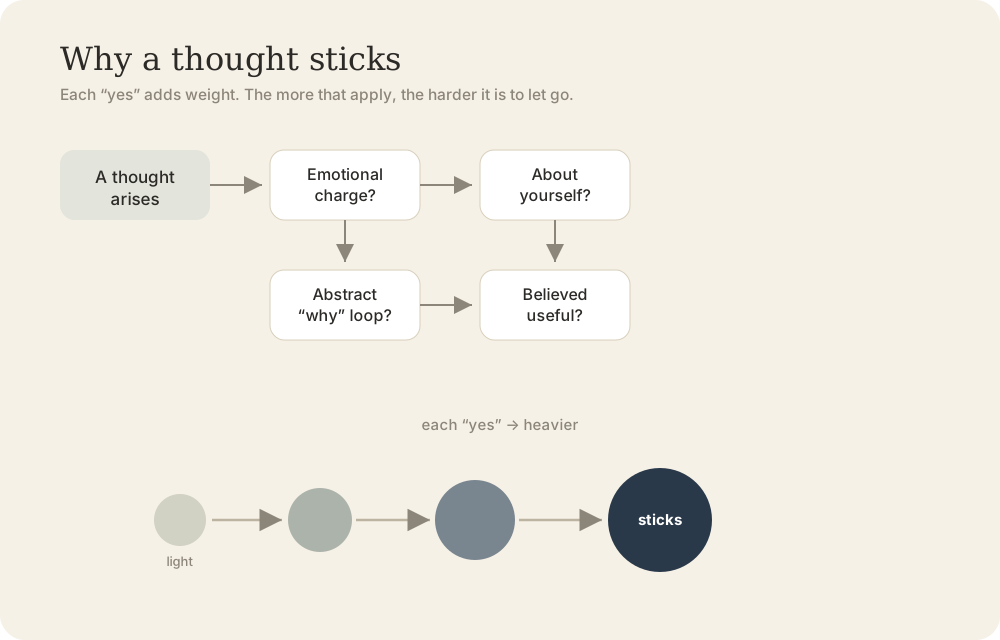
The research points to four factors that make thoughts adhesive. Understanding them is already half the battle, because once you can see the mechanism, it loses some of its power.
1. Emotional charge
Thoughts with strong emotional loading — fear, shame, anger, grief — activate the brain's salience network, which functions as a priority-flagging system. Salient things get attentional resources. That's by design: your brain is built to prioritize what feels important, and "important" in evolutionary terms usually means "potentially threatening."
The result is that neutral thoughts ("I should buy milk") pass through without friction, while emotionally charged thoughts ("I can't believe she said that") get flagged, held, and replayed. Your brain is doing its job — it's just that "helpful alertness to danger" and "unproductive obsessing" use the same neural hardware.
2. Self-reference
Thoughts about yourself are stickier than thoughts about anything else. "The economy is uncertain" has one level of grip. "I might lose my job" has another entirely. The difference is self-reference — the moment a thought connects to who you are, what you're worth, or what might happen to you, it activates the default mode network (DMN), the brain's self-narrative engine.
The DMN maintains your ongoing story about yourself. It's the network that's most active when you're not focused on any external task — and it's the network that meditation researchers have studied most intensively. When a thought plugs into your self-narrative, it gains the weight of identity. It's no longer just a thought. It's a statement about you.
3. Abstract "why" questions
Ruminating thoughts typically take the form of abstract, unanswerable questions: "Why does this always happen to me?" "Why can't I get this right?" "What's wrong with me?"
These questions are seductive because they feel productive. You feel like you're working on the problem. But the abstraction is a trap: there's no concrete answer to "Why am I like this?", which means your mind can keep processing indefinitely without ever reaching a conclusion.
Contrast this with concrete, specific thinking: "What exactly happened? What did I feel? What could I do differently next time?" This kind of thinking has endpoints. It can actually resolve. Abstract rumination can't.
4. The belief that rumination is useful
This one is subtle and powerful. Psychologists Adrian Wells and Costas Papageorgiou discovered that many people hold what they call positive metacognitive beliefs about rumination: "I need to think this through to understand it." "If I analyze it enough, I'll find the answer." "It would be irresponsible not to worry about this."
These beliefs function as permission slips. Every time you notice yourself ruminating and some part of you says "but I should think about this" — that's a metacognitive belief keeping the loop alive. The belief itself is rarely examined, which is what makes it so effective at sustaining the cycle.
And that is also why this belief, when existing unexamined and unquestioned, can be the biggest hindrance to a meditative practice.
What's happening in the brain
Paul Hamilton and colleagues at Stanford showed that depressive rumination is associated with hyperconnectivity between the DMN and a region called the subgenual prefrontal cortex — an area linked to emotional valuation and behavioral withdrawal. In rumination, the brain's self-narrative system and its emotional-weighting system get locked into a reinforcing loop. The self-story generates negative emotion; the negative emotion feeds back into the self-story; and the whole thing becomes difficult to interrupt because both systems are driving each other.
It's not just a "bad habit." It's a neural pattern with identifiable characteristics. And that's actually good news, because neural patterns can change.
Why trying to "solve" sticky thoughts doesn't work
Here's something counterintuitive: research shows that actively trying to solve the problem you're ruminating about is less effective at breaking the loop than simply observing the thoughts without engaging with them.
Susan Nolen-Hoeksema's research found that both distraction and mindful observation reduced rumination more effectively than problem-solving. Problem-solving keeps you inside the same cognitive mode that's generating the rumination. Observation shifts you to a different mode entirely — from being in the thought to seeing the thought.
This is what meditators sometimes describe as the shift from first person to third person. You go from "I'm a failure" to "there's a thought about failure." The content hasn't changed. But the relationship to it has changed completely. And it's the relationship, not the content, that determines whether the thought sticks or releases.
Brooding versus reflection: A crucial distinction
Not all repetitive thinking is harmful. The research distinguishes between two forms:
Brooding is the sticky kind: passive, self-critical, focused on causes and consequences without moving toward resolution. "Why does this always happen to me?" "What's wrong with me?" Brooding predicts current and future depressive symptoms. It's the dead-end loop.
Reflection is the potentially useful kind: a deliberate, curious examination aimed at understanding and insight. "What happened there? What was I feeling? What pattern am I noticing?" Reflection predicts lower future depressive symptoms. It has an investigative quality — warm, open, genuinely curious.
The difference between them is not the topic — you can brood or reflect about the same event. The difference is the stance. Brooding is driven by judgment and aversion: you don't want things to be as they are. Reflection is driven by curiosity and, I'd add, a kind of care: you want to understand, because understanding matters to you.
If I had to name the single most important skill in meditation, it might be learning to tell these two apart — and choosing reflection over brooding. In practice, the cue is often in the body: brooding contracts. Reflection opens. You can feel it, if you pay attention.
What meditation actually does with sticky thoughts
When you sit in meditation and a sticky thought arises, you have a few options. Most untrained minds default to one of two: engage (follow the thought, try to solve it, argue with it) or suppress (push it away, return to the breath with force). Neither works well. Engagement feeds the loop. Suppression creates a rebound effect — the thought comes back stronger, maybe because supressing it kinds of validates it as being "so important and powerfull, that I dont want to handle it".
Meditation trains a third option: observe. See the thought. Note its emotional charge ("there's anxiety here"). Note its self-referential quality ("this is a thought about my adequacy"). Note its abstract, looping character ("this is a 'why' question with no answer"). And then — without following it, without pushing it away — let it be there.
This sounds passive. It isn't. Neurally, observation activates different circuits than engagement. It shifts activity from the ruminative DMN loop toward prefrontal control networks and the salience network. You're not ignoring the thought. You're seeing it from a different vantage point — one where its stickiness becomes visible as a mechanism rather than experienced as an inescapable reality.
And over time — this is the part that takes patience — the relationship changes. The thought may still arise. But it sticks less. Not because you've solved it, but because you are able to allow it to arise without grasping it or wanting to solve it.
A practical exercise
Next time you're meditating and a thought sticks, try this:
1. Name the mechanism, not the content. Instead of getting pulled into what the thought is about, name why it's sticky. "This thought has emotional charge." "This thought is self-referential." "This is an abstract 'why' question." "I have a belief that I need to figure this out."
2. Feel it in the body. Where does the stickiness live? Chest? Throat? Stomach? Shifting attention from the cognitive content to the bodily sensation changes the processing mode — from narrative to sensory, from thinking about to feeling.
3. Ask: brooding or reflection? Am I judging, or am I curious? Am I trying to fix something, or am I trying to see something? If it's brooding — return to the breath. Gently. Without self-criticism. If it's reflection — stay with it. That's good work.
4. Let it be there. You don't have to resolve it. You don't have to push it away. Letting a sticky thought be present — seen, felt, unnamed but unengaged — is the practice. With time, it loosens on its own. Not because you did something to it. Because you stopped doing something to it. Like writings on water...
The bottom line
Some thoughts stick because your brain is doing exactly what it evolved to do: prioritizing emotionally charged, self-relevant, potentially threatening information. That's not a flaw. It's a feature — one that served your ancestors well but can make a meditation session feel like a battle.
The stickiness is not random. It has identifiable components — emotional charge, self-reference, abstract questioning, metacognitive beliefs — and once you can see those components, you have a different relationship to them. Not control, exactly. Something more like clarity.
Meditation doesn't make sticky thoughts disappear. It makes the glue visible. And once you can see the glue, you're no longer stuck in the same way. You're a person seeing a sticky thought, rather than a person having a sticky thought. That distinction — between being in the thought and seeing the thought — is small in words but enormous in experience.